In February, while I was making one of my last big pushes to finish revisions on my thesis, I deactivated facebook for the first time since I'd signed up for it in 2007. When I'm spending most of my time on the computer anyway, it's easy for it to become a time-suck for me. I go down the rabbit hole of articles people have posted, and when there are big things happening in the world, it is my main source of information. The social-commentary junkie in me doesn't know how to turn away. I'm also connected to a lot of great art, literature, and design sites. If I'm not paying attention, I'll look up at the clock and three hours will have passed. Doing what? Not productive work usually. So after I finished my thesis, I decided to do it again to figure out how to reconnect with my world. What's funny is the reactions I got immediately. My mom called me to ask if I'd seen a comic she'd posted. "But you were the only person I'd wanted to see it!" "Then why didn't you email it to me, mom?" "Oh well, it doesn't matter, I will now." My advisor came up to me at a reading Thursday acting funny and I eventually figured out that he thought I'd defriended him. But the truth is, I don't feel disconnected, just unplugged from the constant stream of information. Tarfia called me to tell me that Adrienne Rich had died and I was like, "Let me guess, it was posted on facebook?" And she said "well I was in a meeting, but Sarah who was also in the meeting found out by checking facebook." I've found that now I'm reading articles all the way through, which I seek out on my own by going directly to the Rumpus, or the Atlantic or The New York Times...who knew such a thing were possible?
Sigh.
Actually though I find myself spending a great deal of time sitting in silence. For two years I have been working to produce my thesis, and now I have. It is produced, printed out, turned in to the library to be bound and catalogued. And now feels like the fallow period where I am relearning how to be with my thoughts. (Even this blog post will likely go out into the ether unread, as I won't be informing anyone of its existence.) Bits of poems are beginning to well up and spill out in fits and starts, but nothing to completion. They are coming on strangely. One as a telegram. One in a stream of because. Elizabeth Spires was here last week, and she talked about a book that she uses in her undergraduate workshops called The Zen of Creativity. She said that every time she reads it, she finds herself renewed, more open to certain images, and less likely to hold on to more complicated and unnecessary adjectives in her poetry writing. Though she's never been one for meditation, she recently had this image come seemingly out of nowhere of herself with her arms stretched around a huge black boulder. And she didn't know what the image was for, but my guess is there's a good chance it's going to end up in a poem. She said she also knew the image wouldn't have come to her if she'd been plugged in to the constant media stream.
The week before Beth came, Maurice Manning was here. Now, I first have to say: I have never in my life experienced a greater discrepancy in how a poem read on the page versus how it read aloud. For me, Maurice's lines were completely flat on the page. The phrasing was unclear, the voice uninteresting--it all seemed to be in one dull tone that I glided across, forcing myself through. Bucolic? Well, I think my first experience of his book is also how my experience of the countryside would be if I had to be there every day of my life. But then he showed up for a Q&A and began to talk about how he had crafted these poems. And he got out a cardboard box and pulled out these wooden objects, made out of, seriously? plywood? And he started to talk about how in order to get into the stripped-down mindset he imagined the speaker of these poems having, he needed something to ground him, tether him. And so he began to build things as he was writing the poems. One of them he passed around and he had glued individual pieces of hay and made a haystack. And above it he'd drawn a bird with a red beak. To make the beak red, he'd used a crude triangle of crayola. And next to that was another bird with a black beak. And off to the side in very childlike handwriting he'd written in pencil: Hay stack + bird + bird is a good sign.
On another piece of plywood, there were jagged marks that could have represented either waves or grass and a stick figure lying alone among the expanse. And in the same spare pencil scratches he'd written: Man not dead, just resting.
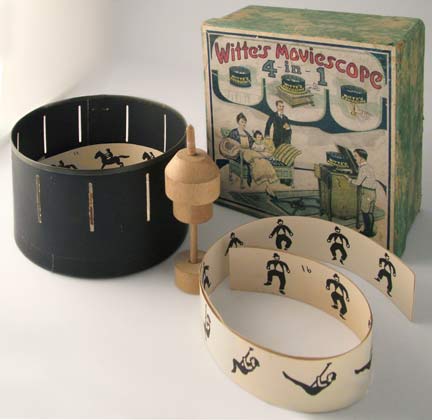
The most complicated of all was a pseudo-zoetrope. It was painstakingly crafted and he'd taken images from his poems and put them on a long strip of paper with the scraps of lines they were taken from below the images. the wheel rotated on the spindle but the wheel itself was solid so the images were on the outside, and he'd mounted a viewing scope to focus on single images on the wheel while you spun it. It was crude but utterly fascinating and kind of brilliant. Because his poems aren't punctuated or capitalized, and often don't use line breaks to mark phrasing, I had a lot of trouble figuring out how to read them. But after I saw him read twice, everything for me shifted. They came alive completely. These are not poems for the page, they are poems for the air.
XLIII
if I say I've sprung the spring in my step
does it matter Boss does it matter much
to you when I can't even spit
without it feeling bad when I
can't look the old horse in the face
without a tear on mine because
I know where all days go when they
are done they don't come back they won't
wake up the sun won't show its face
again which means there isn't much
to look at Boss not much to look
at in the dark not even you
you keep a lot of secrets Boss
but now I know a secret too
although the tallest tree may reach
your chin I know one day you'll bend
it over Boss without a speck
of pity not a moment's pause
you'll drag it to the darkest ground
all days go one direction down
While I've been not dead, just resting, a lot of reading has occurred. I've recently discovered/was slayed by finding Martha Collins, and I just started her two books White Papers and Blue Front, the latter a book-length poem based on her father's witnessing of a lynching outside a restaurant when he was a boy in Cairo, Illinois. I'm slowly making my way through Traci Brimhall's new book Our Lady of the Ruins, as well as Ruth Stone's What Love Comes To. Tammy, my friend who I met years ago while I was documenting the Small House Movement, posted some really interesting links the other day, including this video from the TED conference by a woman about the importance of introverts.
Her description of what she expected summer camp to be reminded me of every road trip and fishing outing I ever went on with my family. My dad would look up into the rear view mirror and say "Amanda, look at the _____, you're missing it!" And I'd glance out the window for a moment and then go right back to whatever I was reading. I always had the maximum amount of books checked out from the library that I could. When I went fishing with my mom, brother, and grandparents in the summers, I'd ride in the front of the boat by myself and lay down on my stomach itching for the moment we emerged from beneath the railroad trellis and my grandfather could push the throttle forward as the nose of the boat would lift, water spraying onto my face, the wind making it hard for me to keep my eyes open, but I would grip onto the edge with my hands, feeling pure elation for the 5 or 10 minutes it took to get to the fishing spot. And that was it. That's what I came for, not the fishing. I'd then spend the next two or three hours lying at the front of the boat holding my book up to block out the sun. As the years passed, I got to the point where those few minutes weren't enough reason for me anymore. I stayed in and slept, until I was ready to rise and read in the air conditioning.
Another article Tammy posted was on how love can affect our brain chemistry. Her father recently had a stroke and the author of the article wrote a book that was recommended to her. I've heard about how love can affect dopamine and the experience of pain, but something in this article seems to be addressing something new. Or a different domino fell into place for me. I think maybe it was the flip side of the equation. Yes, really being in love, being with the right person does all these great things, it actually keeps you from feeling pain, it gives you energy, your brain can make connections faster, can reclaim lost memories and language. But the flip side: why then would you ever spend time with the wrong person? Or not with the right one? It's fucking science.
As for me, I think my brain is making connections faster as a result of my facebook fast, and I'm reclaiming the language I lost in so many months of writing and revision. Now I'm spending an inordinate amount of time on the island of my bed with other people's words and poetry, trying to scrap together my thoughts again. What island are you on? I'll send a telegram.